

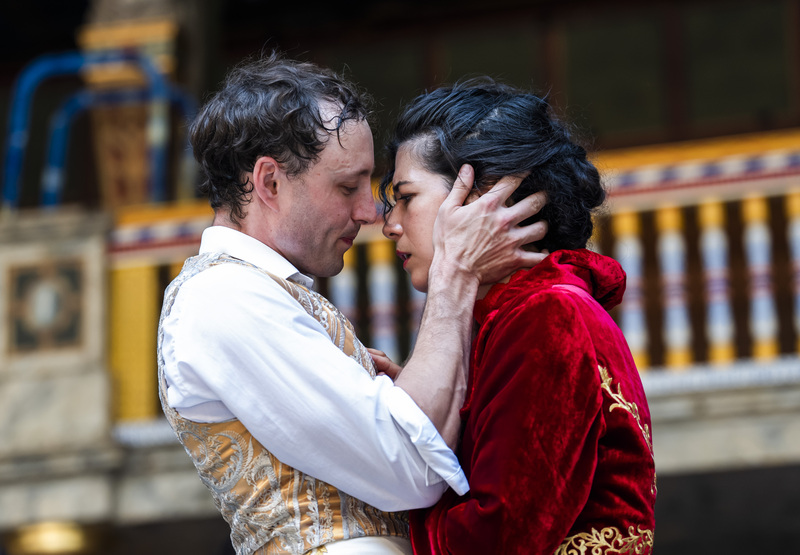
Review by Simon Jenner, August 5 2026
★ ★ ★ ★ (★ )
Summer-drenched pizzazz and spectacle could hardly have been better timed. And timing in this flamenco-inflected production brings Navarre out of a study’s no-place and into Technicolor. A customary gentility hemming this 1595 celebration of the limits of language gets an infusion of blood in more than one sense. Love’s Labour’s Lost directed by Indiana Lown-Collins plays at Shakespeare’s Globe till September 13.
With Carmen Igarza’s movement and choreography, and co-composers Michael McMahon and Adrián Solá filleting in a couple of almost-pop-standards through their inventive score, the music hardly pauses. The production also features flamenco dancers Pablo Egea and Anita La Maltesa, with singer Carlos Lobo Cordón.
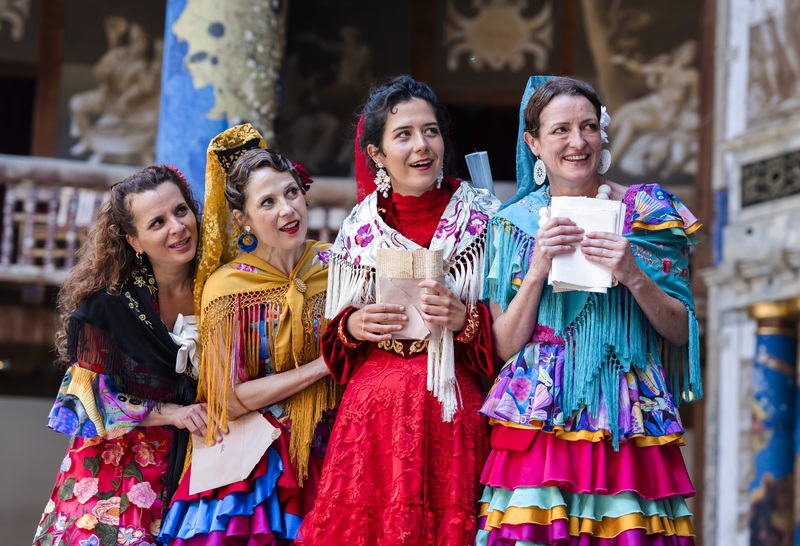
Suzanne Ahmet (Katherine), Bea Segura (Rosaline), Norah Lopez Holden (Princess), Katy Stephens (Maria) in Love’s Labour’s Lost, Shakespeare’s Globe. Photo Credit: Tristram Kenton
Katie Lias‘ set consists of gorgeously blue and spangled columns, with an Alhambra look – which the Globe stage easily transforms into; as if finally revealing its colours. However apart from the large puppet heads in the nine Worthies, it’s the gorgeous costumes which shine, and a few set-pieces like the bloody bullring pitched amongst the Groundlings.
Dresses with their reds yellows greens and blues set off the virginal white of the four men and their “little academy”. They almost stain them with reflection. Here the flamenco and bullfighting culture gives a Macha licence for the visiting court of princess and ladies-in-waiting to enact a liberation of body and wit.
Arditti is magnificent as Berowne, clarion-voiced where needed, authoritative and extremely funny when found out. Arditti has to bestride as the reasonable man more aware of himself than his friends; but piqued with self-delight and betrayed to a levelling hypocrisy in occasion.
Jax Guerrero is hemmed a little as Dumaine but delights in the unusual doubling as Moth in a fantastic boater. Philip Labey’s Longaville brings a reserve of panache but the chief point – emphasized with Ned Costello’s youthful King of Navarre – is to show them all as boys to Berowne’s man.
Norah Lopez Holden’s Princess of Spain (not France) is a revelation. Especially when bullfighting a progressively bloodied Daniel Abbott, elsewhere Mozo De Espades’ bullfighter attendant! Katy Stephens often at the Globe takes a raunchy Maria (and a stiff Holofernes) and rings out vocally; whilst Suzanne Ahmet’s commanding Katherine also makes more of her part than normal (and briefly as black-suited finger-wagging curate Nathaniela). Arch and commandng she makes her final conditions ring. Bea Segura’s Rosaline has to match Arditti and uses verbal pauses, twisted poignards and like him a truth that breaks through the badinage.
Daniel Crossley when released from Constable Antony Dull is a superbly-voiced Boyet, on a level pf clarity with Arditti. It’s not normally a major part but turquoise-suited Crossley makes it his own.
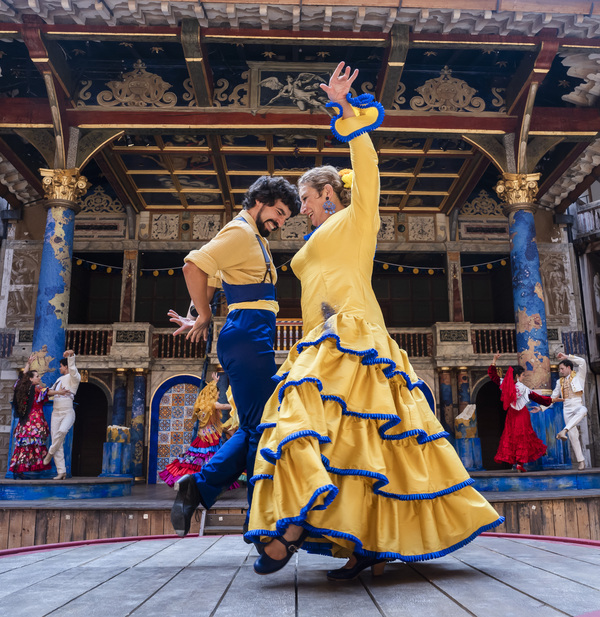
Pablo Egea and Anita La Maltesa in Love’s Labour’s Lost at Shakespeare’s Globe. Photo Credit: Tristram Kenton
There’s enormous and detailed fun with Spanishing words and jokes on “cahones” or “luuurve”. Physical jokes – particularly as each male lover discovers himself to the others – is a tour-de-farce. Arditti repeatedly shooting under a giant escritoire for instance.
Joshua Hill’s Costard with his Spanish Ed “rununeracion” versus guerdon is just a little of his armoury, delivered in rustic British. Jimena Larraguivel as Jaquenetta is a ferocious delight, matching and twitting Hill: her kiss makes you wonder why she really swaps his Costard for Don Armado. Andro Crespo makes a believably exqusite gull of Don Armando turning sonnet. Crespo launches phrases like galleons, complete with sails out of his mouth. Zannie Benfield’s Marcadé as the Messenger actually embodies the darkness she brings with her: it’s usually a striking change, but here you can see the air grow dark over a too-bright day.
The costumes reach dizzy depths with the Chippendale-infused Russian garb the men bring on, to merciless – and pretty exposed – derision. With the giant puppet headed Worthies comes a surprise as Larraguivel’s Elizabeth 1 repeatedly “of England and Ireland” (a provocative kick to imperialism) gives her Tilbury speech: but is equally derided as “a wrinkled regina”. It’s just one of the wild inventions that Shakespeare mightn’t have scorned if he could have got away with it.
Usually the Worthies conclude earlier but here the confrontation between Costard and Don Armando over the pregnant Jaquenetta is visceral and darkens into a savagery that precedes the denouement. Yet everything’s soon contained in the extended flamenco they swirl through the whole production. When it stops the players are breathless. There’s truth and passion in the final reckoning and bartering for love. The last Flamenco song led by Crespo strikes the right melancholic note with Shakespeare’s curious lyric, and some Spanish even to the last lines.
Associate Director Nell Bailey.
Co-composers Michael McMahon and Adrián Solá both on guitars, David Delarre on Laud, Percussion Ayoze de Alejandro Lopez
ASM Rachel Middlemore, DSMs Devika Ramcharan, Stage Management Placement Francesca Wolff, Stage Manager Jenny Skivens
Globe Associate Movement Glynn MacDonald, Costume Supervisor Jackie Orton. Fight Director Enric Ortuno,
Digital Artist Billy Bull, Scenic Artists Suanna Buarton, Kitty Rice
Head of Voice Tess Dignan, Voice Coach & Text Adam Wallis, Wellbeing Lead Brenda Moore-Wait.
Head of Stage Bryan Paterson, Head of Props Emma Hughes, Head of Wigs and Make-Up Gilly Church. Casting Becky Paris CDG, Casting Associate Alice Walters, Production Manager Wills, Deputy Company Manager Kristy Bloxham, Assistant Producer Sharni Lockwood, Producer Tamara Moore.
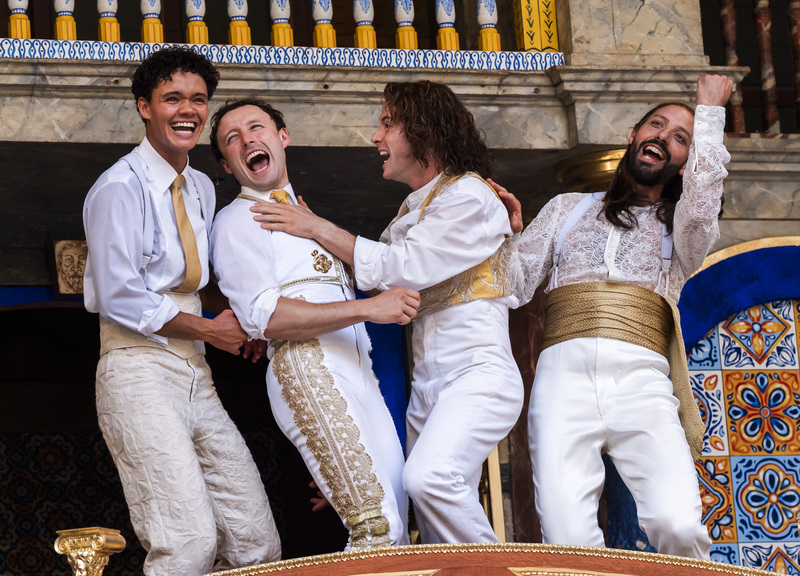
Jax Guerrero as Dumaine, Ned Costello as King of Navarre, Philip Labey as Longaville, and Philiip Arditti as Berowne in Love’s Labour’s Lost at Shakespeare’s Globe. Photo Credit: Tristram Kenton