

Review by Simon Jenner, June 20 2026
★ ★ ★ ★
It’s probably difficult to mount what many good judges claim to be the greatest British play of the century so far unless the production is near outstanding. And Tower Theatre have the advantage and challenge of an open amphitheatre on a blazing day. The foliage at the venue (Rooster’s Wood for the evening) makes pleasant murmuring sounds all around.
Jez Butterworth’s masterpiece directed by Jonathan Reed arrives at Brighton Open Air Theatre until June 20. It contains overall the finest ensemble for Jerusalem I have seen outside of the original with a standout bravura performance from Giles Fouhy.
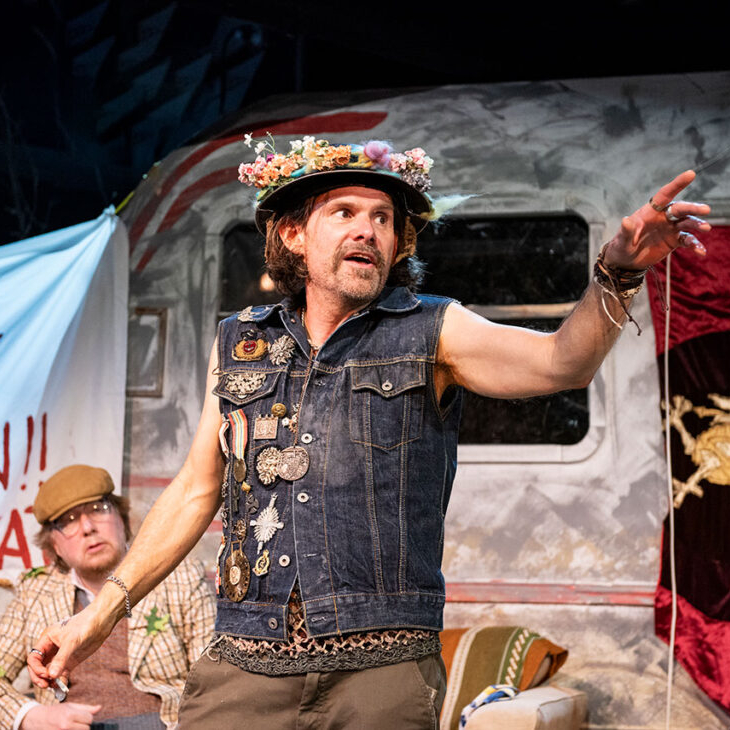
Fouhy’s portrayal of Johnny “Rooster” Byron is a phenomenal tour de force. Wiltshire’s Oberon, Lord of Misrule, drug dealer to the under-aged, protector of the young from predators (however that might appear) and drunken smasher of television sets are all aspects that meld into Fouhy’s outstanding central performance based on Rooster’s famed strut.
But Fouhy, wisely, does not overdo the character’s thrusting-chest gait and roll of both authority and slight self-mockery. He captures the oracular pride though, as a spellbinding orator. Whatever bull and bullshit in his voice, he convinces you of a truth that threads through it all. It’s only at the end that we find out what truths if any are permanent qualities within his boasts.
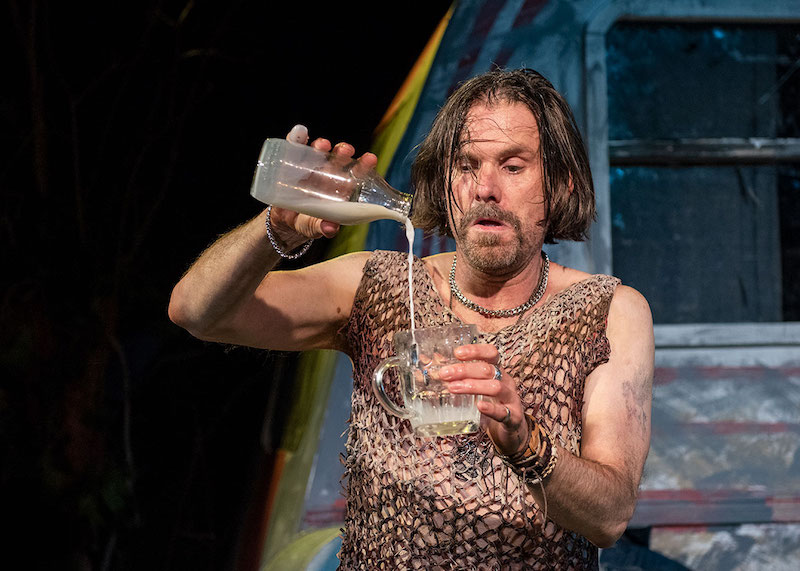
Giles Fouhy as Johnny “Rooster” Byron in Jerusalem, Tower Theatre. Photo Credit: Pau Ros
“If you ever get in any bother … just bang this drum and us, the giants, we’ll hear it, and we’ll come.” Meeting a giant on the A14 at dawn, who casually drops that he built Stonehenge is one clue. After all he gifts Rooster a drum. This to a man who has been kidnapped by Wiltshire traffic wardens but come through the experience. Apparently.
Just one day, April 23 of course, is spanned in this classically framed epic of cornering. Rooster is persistently harassed by two council officials as authorities set to evict him. “Now kiss my beggar arse, you Puritans!” The day unfolds as Flintock Fair gets underway. Once Rooster adorned it as a daredevil rider, so they say.
Now Rooster is confined to supplying and curating raves until dawn where he can’t remember everything he did. And yet he has all the answers to Trivial Pursuit questions. Characters emerge, three of them unexpectedly. A cast of 13 swirls around Rooster in his day of reckoning through this three-act play that spans three hours.
The set is remarkably detailed for an outdoor or Brighton Open Air Theatre (BOAT) configuration. It is designed by Rob Hebblethwaite and Sophie Clark who craft a corner of England around Rooster’s striking (and red-striped but not crossed) caravan. The green stage is festooned with Rooster’s own detritus including surprisingly genteel chairs, record players, bric-a-brac and a whole flourish of bush stage-right of the caravan. This is St George’s Day and there is a deeper country. Even the St George myth gets explored. Matters are lit in a bright sylvan glare deepening to shadows by Andy Peregrine on evening performances while matinées take care of themselves. Laurence Tuerk’s sound design blossoms spectacularly at the end.
Tim Waghorn’s hangdog, dependant yet witty Ginger is more complex than he seems, and is another outstanding performance. Ginger is hurt that he was excluded from the latest rave. Despite using Rooster like everyone else, he brings genuine warmth, even though he is too much of a coward to go against the flow. And that has connotations, courtesy of a (happily unseen) video once shot to mock Rooster.
Richard Tinworth’s blissed-out Professor, seeking his missing dog Mary counterparts Rooster in his fantastical metaphoric arcs of Old England, and his capacity for mistaking Ginger as a forward woman. Tinworth in his debut with Tower Theatre brings a warm-slippered charm to the loopy side and a baffled authority to the Professor’s lore even as he slyly asks “pure or applied?” to Ginger’s DJ claim.
Truculent Davey (a barrelling and roistering Liam Stewart) is in his way as deeply invested in England as Rooster. He will not go further east than the shire border. Stewart’s fantastically dour persona wafts authentic stuck traditions as he slaughters 400 cows a day in his abattoir. Wiltshire is in his blood; he drains so much of it. Lee (played by Morgan Buckley), leaving for Australia, makes an appealing if slightly venal young man. Buckley invests him with dignity and pathos in his gawkishness. Unlike everyone else though, he is prepared to take his chance, and Buckley shows his latent courage memorably.
Of the possibly under-age girls, Pea (a sassy Catherine Reid), is more sceptical, and Tanya more sexually forward (Lulu Freeman in her second main role, like Reid making her Tower Theatre debut). Tanya’s offering herself with some bluntness to departing Lee constitutes a witty two-person chorus. This is at its best during the uproarious Trivial Pursuit (Genius 2000 edition) scene. You feel for Freeman’s warmly available Tanya as Buckley’s Lee politely but firmly rejects her.
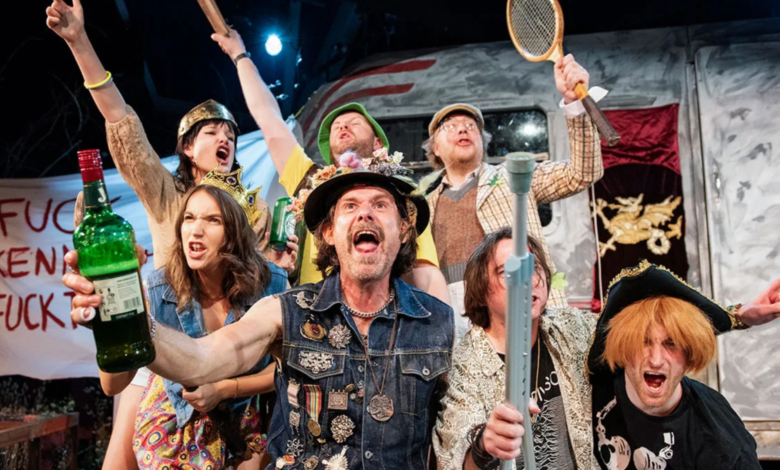
The Company of Jerusalem, Tower Theatre. Photo Credit: Pau Ros
Amy Bloomfield’s evanescent Phaedra threads through from the beginning like an apparition singing enchantment, flitting through the narrative. Then she stops and makes an appeal. She is traumatized and Rooster, the opposite of predatory, empathizes. Bloomfield’s vocal projection is challenged outdoors. The spreading of her wings shows off the most wondrous moment of Kate Els’s costumes too. Each character is pinpointed with scruff or scuzzy wear, threadbare or ill-fitting.
One of the latter is Martin Shaw’s bells-and-bangles Morris dancer Wesley: here an on-point study in how Rooster reaches even to nominal antagonists. Wesley runs a pub but still needs ‘whizz’ from Rooster. At moments he confides his real fears and his own marginalization by the corporates and bar staff. Shaw’s comedic, mis-timed dances strung along by Rooster’s drugs, shimmer like another English apparition. Tower even consulted Jonathan Norris’s Morris dancing expertise.
The use Tower Theatre make of the whole of BOAT’s outdoor space is a green sweep of energy. They don’t exit through the audience as some bespoke BOAT productions do – it’s a touring company – they own the whole stage. And the stage is used with something like the naturalistic flourish you would expect from a real wood clearing. Actors are nearly always turning to be heard, without drawing attention to this.
In this three-hour-fifteen-minute production with two brief intervals, it’s hardly surprising a slight drop of energy is discernible in Act Three, partly due to Butterworth’s writing: a chorus of farewells and comeuppances as each character exits to allow two very different reckonings. Many of the cast are outstanding though, with vocal heft challenging in an outdoor space.
This near-flawless production of weight and substance is a triumph. Above all, Fouhy’s charismatic, shapeshifting Rooster becomes seared into the memory. Credit is due though to each one of the cast and team.
Previously published in Plays International and Europe, whose kind permission to reproduce it here is gratefully acknowledged. Editing and sourcing by Jeremy Malies.
Production and Stage Manager Nichola Vsaey, Assistant Directors Ellie stones and Jaeger Hong, Movement Director Rebeca Pereira, ASMs Alan Wilkinson and Sangita Modgil
Lighting Operator Alan Wilkinson, Sound Operator Laurence Tuerk, Costume Assistants Lucy Moss, Carmen Otero Loira, Izzy Putt, Properties Michelle Balgobin, Intimacy Coordinator Romain Mereau,Fight Coordinator Richard Kirby, Ensemble Direction Angharad Ormond
Morris Dancing Consultancy Jonathan Norris, Photography Pau Ros, Set Construction Andy Hind, Emma Brown and members of the Company.

The Company of Jerusalem, Tower Theatre. Photo Credit: Pau Ros